
Journal
What Actually Makes a Superyacht a Superyacht
The technical definition is 24 metres and a paid crew. The real definition is the moment a boat stops being a possession and starts being a jurisdiction.
First published June 2021 · revised July 2026
Every summer, someone at a marina bar points at something white and enormous on the horizon and asks the same question: at what point does a yacht become a superyacht? The technical answer is dull — 24 metres at the load line, professionally crewed — and almost nobody who owns one has ever quoted it. The real answer is more useful. A superyacht is the point at which a boat stops being something you own and becomes somewhere you rule.
The rarest club afloat
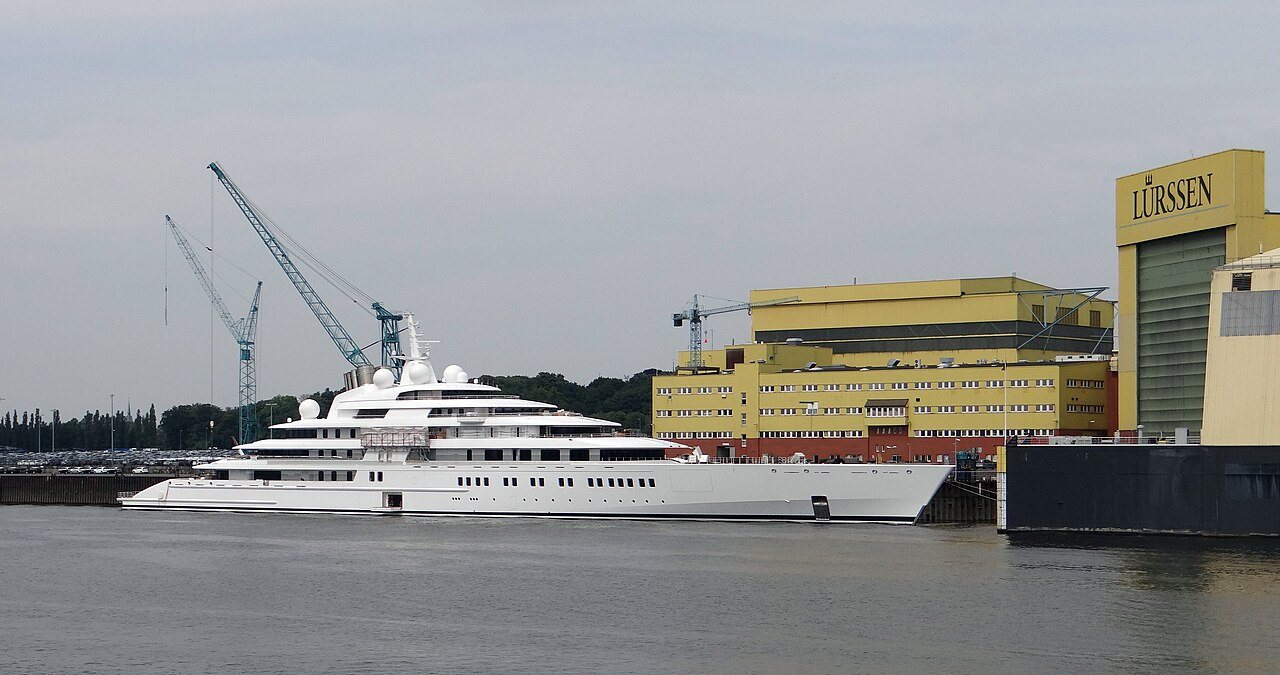
Start with scale, because the numbers are smaller than most people think. There are just over 6,000 yachts in the world longer than 30 metres — fewer than there are branches of Starbucks in California. Nearly two-thirds of them sit between 30 and 40 metres. Push past 80 metres and you are down to roughly 180 vessels on the entire planet, a fleet that would fit comfortably into one arm of Port Hercule. The yards deliver around 170 new boats a year, which is why the waiting list at a serious builder runs three to five years and why owners guard their slot like a title deed. At the far end of the spectrum sits Lürssen's 180-metre Azzam, still the longest private yacht in the world thirteen years after launch — proof that at this altitude, records are not broken casually.
A ship that answers to one person
The original version of this piece, written in 2021, argued that the point of a superyacht was safety and jacuzzis. It was half right about the first and entirely missed the second. Below 24 metres you have a boat: you drive it, you fuel it, you worry about it. Above that line you have a ship — a licensed captain, an engineer who knows every valve by name, a crew who have crossed the Atlantic more often than most airline pilots. When the weather turns off Corsica at two in the morning, you are asleep. That is not a luxury feature. That is the entire product.
The cruise-ship comparison the old article leaned on gets it backwards. A cruise ship distributes a taste of luxury among five thousand strangers on a fixed itinerary. A superyacht concentrates the whole thing on twelve guests and asks them, each evening, where they would like to wake up. The spa, the cinema, the toy garage full of tenders and Seabobs — all pleasant, all replicable ashore. What cannot be replicated ashore is total privacy that moves. No paparazzi lens reaches an anchorage three miles off Formentera. No neighbour ever drops by uninvited. For people whose lives are lived in public, that is the one commodity money otherwise struggles to buy.
Charter first — many never stop
The intelligent way in remains the charter, and the fleet has never been deeper: more than 2,000 yachts over 30 metres are available for hire, from a 30-metre family workhorse in Greece to a 100-metre statement piece with a helicopter deck and a crew of fifty. A week on a well-run 45-metre in the Mediterranean will teach you more about what you actually want — beach club or sundeck, formal dining or barefoot — than a decade of boat shows.
It will also teach you the arithmetic. The old rule of thumb still holds: running a superyacht costs roughly ten per cent of her value every year, in crew salaries, fuel, insurance, berthing and the yard bills that arrive whether you used her or not. A €50 million yacht is a €5 million annual commitment before you have poured the first drink. Some of the sharpest owners in the game have run the numbers and concluded that chartering someone else's boat for six weeks a year is the better trade. Others ran the same numbers, signed the build contract anyway, and have never regretted it for a moment. Both are right.
The thing itself
So what makes a superyacht special? Not the heated floors. Not the length, exactly, though length buys the rest. It is that a superyacht is the last genuinely private territory left — a place with your flag on the stern, your people on deck, and your name on nothing that anyone ashore can search. Everything else the modern world has managed to index. This, it hasn't. That is what the money is for.